


AI-Powered Precision for Risk of Recurrence Prediction
Ataraxis Breast provides personalized recurrence risk prediction for stage I–III breast cancer patients. By analyzing morphological features from standard H&E slides together with clinical data, the test delivers a precise risk estimate to help personalize care.
5-year recurrence risk across all subtypes:
Deeper prognostic insight for personalized treatment planning
Introducing next-generation technology for prediction of breast cancer recurrence

By providing a clear high or low 5-year recurrence risk results, Ataraxis Breast helps resolve uncertainty in challenging and inconclusive cases, such as patients considered to be intermediate risk or borderline by standard clinical characteristics and genomic tests.

Ataraxis Breast's recurrence risk prediction was developed and validated using data from all early-stage breast cancer patients, including HR+/HER2-, but also triple-negative (TNBC), HER2-positive, and triple-positive breast cancer.

Ataraxis Breast's recurrence risk prediction was found to provide independently prognostic information, unique from standard clinicopathological features and genomic assays.
How do we predict risk of recurrence?


Development & Clinical Validation
Robust development and validation data
Ataraxis Breast’s recurrence risk prediction capability was developed and validated using data from 8,161breast cancer patients treated at 15 institutions in 7 countries.
The study included patients with all subtypes of early-stage and locally advanced invasive breast cancer, marking this as one of the most comprehensive evaluations of a prognostic/predictive test.


Over 50% improvement in accuracy compared to standard of care genomic tests
In validation across three external cohorts from leading international cancer centers, Ataraxis Breast reduced error in predicting 5-year recurrence risk by approximately 50% compared with standard-of-care genomic assays for hormone receptor-positive invasive breast cancer.
Works in all clinically relevant invasive breast cancer subgroups
Ataraxis Breast’s recurrence risk prediction capability was developed and validated on robust and diverse data from 7 countries. The data included previously underserved groups, such as triple-negative breast cancer patients. Ataraxis Breast was shown to be consistently prognostic across groups with various age, race, molecular and histological subtype, and nodal status.

Ataraxis Breast stratifies patients in challenging subgroups where genomic assays fail
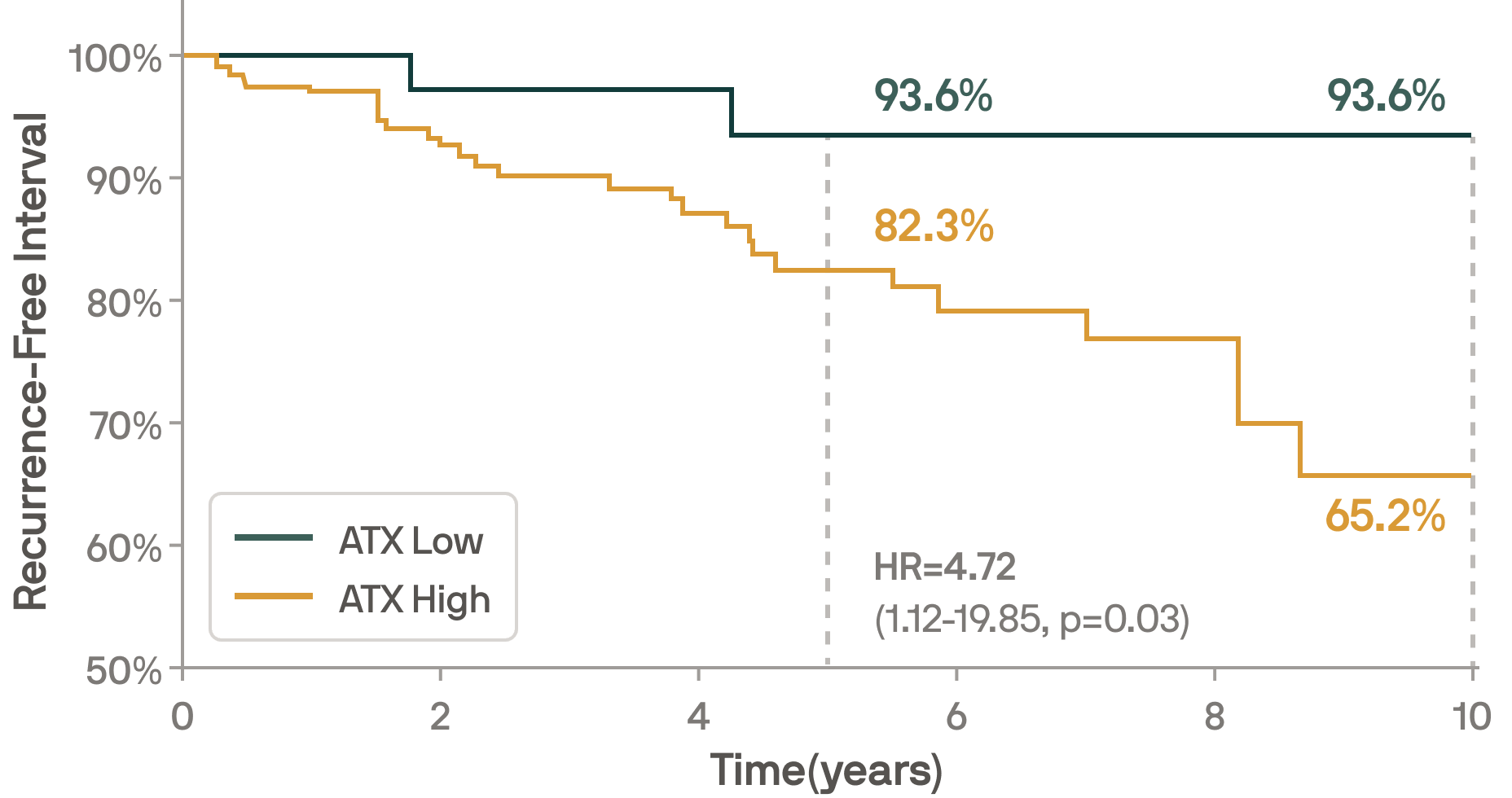
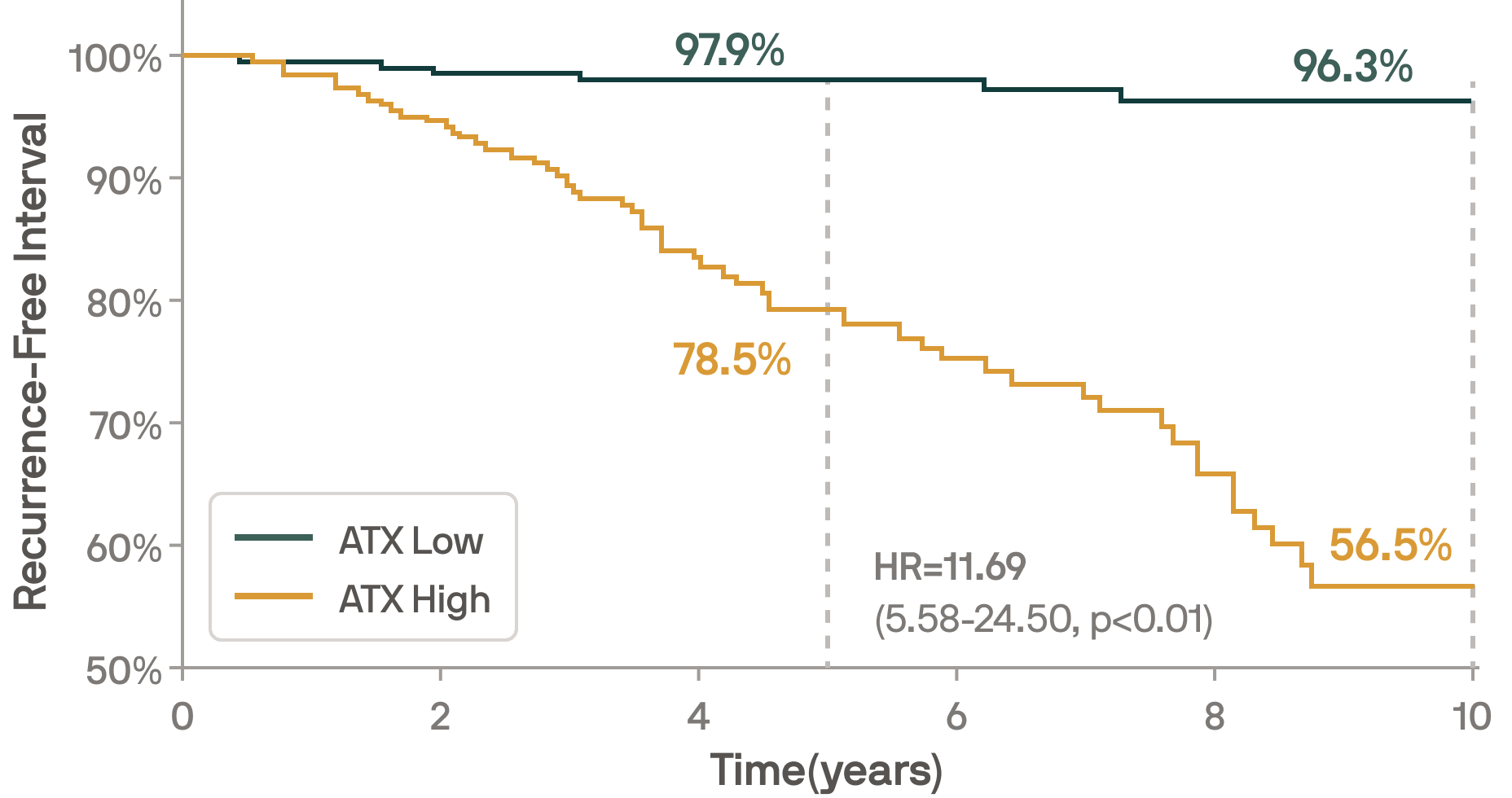
Superior calibration to real-world outcomes
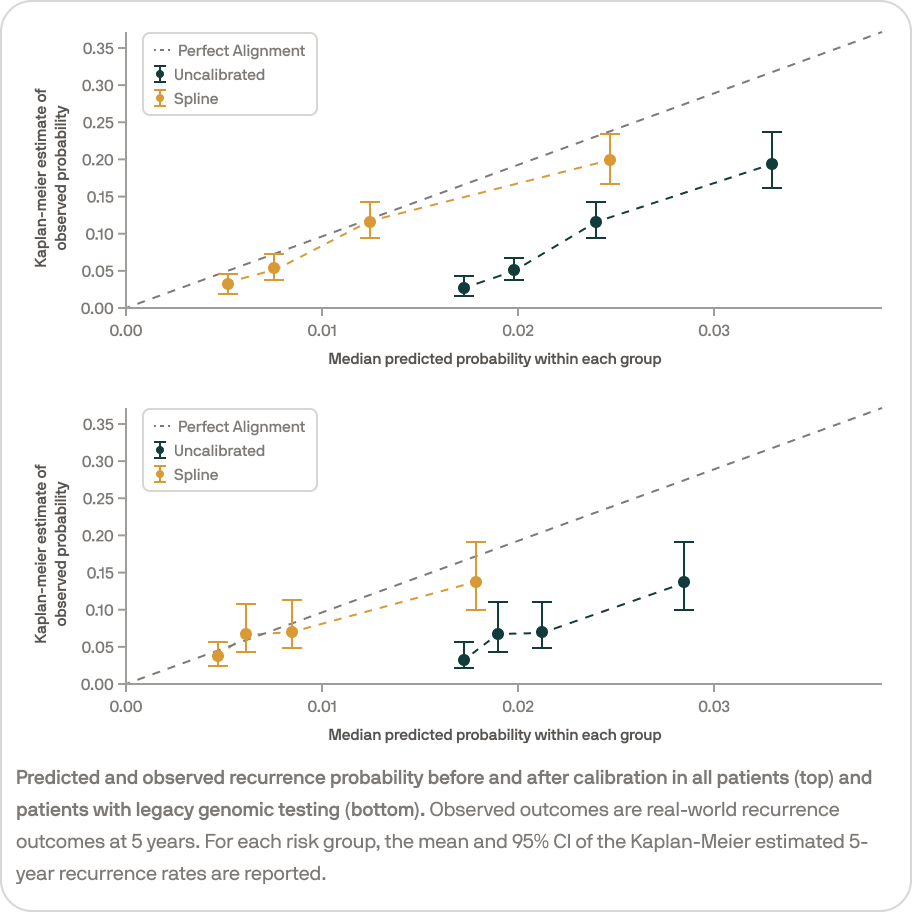
Traditional prognostic tools, including widely used genomic assays, often provide relative risk scores. These scores indicate who is higher or lower risk within a population, but they do not reliably match the true recurrence probabilities patients experience in practice.
Ataraxis Breast's 5-year recurrence risk prediction is fundamentally different. It is designed not only to rank patients by risk, but to produce absolute risk estimates that reflect what actually happens in real-world cohorts.
What this means in practical terms:

Why calibration matters clinically: A well-calibrated model allows oncologists to act on the absolute value of the prediction, not just its relative position, making treatment escalation or de-escalation safer, clearer, and more evidence-based.
View a Sample Report
Explore our sample report and learn more about how predictions made by Ataraxis Breast can help in recurrence risk assessment and making more personalized decisions about treatment.
Make the most informed call for your patients.
What is my risk of cancer coming back in 5 years?
Get a clearer recurrence risk result without the wait or the gray zone
Legacy recurrence tests, such as the majority of genomic tests, can take weeks to get a result and still leave many patients in an unclear “intermediate” category. Ataraxis Breast is designed to address those exact issues, and it can be used for early-stage breast cancer across:
- All molecular subtypes, regardless of ER, PR, or HER2 status
- Premenopausal women and postmenopausal women
- Regardless of cancer presence in lymph nodes
We start with the tissue your care team already collected during biopsy or surgery. Our advanced AI platform analyzes thousands of microscopic tumor features, along with basic clinical information, to estimate your personal risk of breast cancer recurrence.

I might want this test if...

I want a better sense of whether my risk of recurrence is lower or higher, and I want a prognostic tool validated across breast cancer subtypes.
I want additional insight to help decide on treatment—especially if I'm premenopausal or have lymph node involvement.

I want to reduce extra weeks of anxiety and get a clear result sooner, so I can start my treatment plan as soon as possible with my care team.

I want the most realistic recurrence risk estimate for my specific cancer type and feel confident that I am not being over-treated or under-treated.
How do we predict risk of recurrence?
Ataraxis Breast was validated in patients like you

Our Ataraxis Breast platform has been developed and validated using recent data from thousands of real patients around the world. Our clinical studies show that the Ataraxis Breast model for predicting breast cancer recurrence risk can distinguish between low and high risk across patients with early-stage breast cancer, regardless of age, race, molecular subtype, or histology.