


First Phase III Randomized Controlled Trial Validation Study Readout Presented at ASCO 2026

At ASCO 2026, Ataraxis presented results from a secondary analysis of the Phase III randomized controlled trial, UNIRAD, demonstrating that Ataraxis™ Breast accurately stratifies patients with node-positive HR+/HER2- early breast cancer and finds patients who, despite being clinically high-risk and eligible for adjuvant CDK4/6 inhibitors, achieve excellent outcomes with chemoendocrine therapy alone. Following NATALEE and monarchE trials, CDK4/6i became a standard of care for a large part of HR+HER2- patients, despite recurrence risk reduction being modest, and drugs carrying real costs and toxicities.Identifying which high-risk patients truly need escalation, and which can do just as well with chemoendocrine therapy alone, has become one of the most consequential treatment decisions in early breast cancer.
Validated in a Phase III RCT: ATX successfully stratified 689 patients from the PhIII UNIRAD trial (HR = 2.83, p < 0.01). Under today’s standard of care, patients in the UNIRAD trial would be eligible for treatment with adjuvant CDK4/6i. Importantly, ATX was able to identify patients who – despite being clinically high-risk – had excellent outcomes (91% 5-year DFS) with chemoendocrine therapy, without further escalation. Full ASCO abstract can be accessed HERE.
These results build on our previous work demonstrating Ataraxis™ Breast's utility in CDK4/6 inhibitor selection (McAndrew et al., 2026).
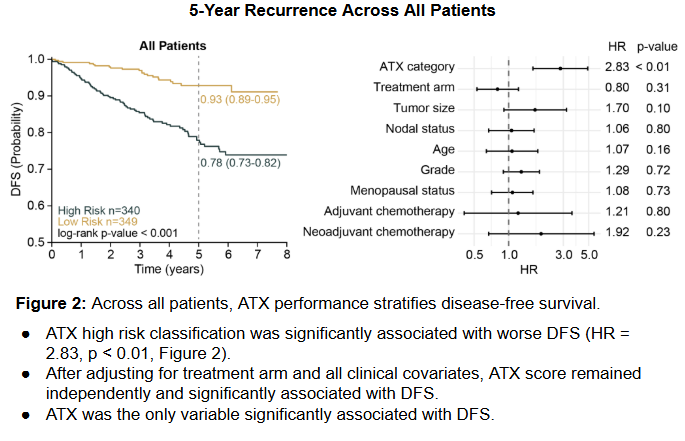
Across all patients, ATX performance stratifies disease-free survival.
- ATX high risk classification was significantly associated with worse DFS (HR = 2.83, p < 0.01, Figure 2).
- After adjusting for treatment arm and all clinical covariates, ATX score remained independently and significantly associated with DFS.
- ATX was the only variable significantly associated with DFS.